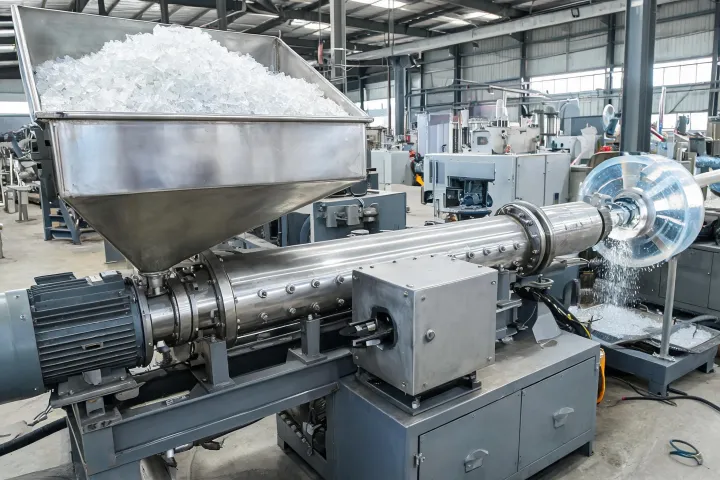
pe waste plastic pelletizing line
A pe waste plastic pelletizing line is selected against the scrap you will actually feed, the washing state of that scrap, and the pellet tests the next process will run. Wet film, labeled bottles and clean PE trim do not share one filtration mesh or vacuum duty. This page maps those operating contexts. It does not convert a brochure kg/h into a plant result. Plastic Pelletizing Line Sourcing remains an independent sourcing partner; factories confirm feasibility for the named feed.
industries evidence review
Decision dependencies
- Application boundary
- The application is converting polyethylene waste into pellets for a stated downstream use such as pipe, film or injection regrind. A generic recycling line that also washes, sorts and agglomerates is a different project. Upstream shredders, friction washers and hydrocyclones, and downstream silos or bagging, belong in the RFQ only when you ask for them as separately priced interfaces. Viscosity and melt-flow of the PE lot, if known, belong with the feed description because they change screw and die selection.
-
Input dependency
- Required input
- Polymer family (PE), waste origin (bottle flake, film, mixed post-consumer), washing status, moisture, paper or metal contamination, bulk density, required pellet kg/h with the test screen, and the pellet properties the next process will measure (moisture, fines, bulk density, colour if relevant).
- Owner
- The buyer’s process engineer or procurement owner supplies the scrap description and the downstream test list. Plastic Pelletizing Line Sourcing does not invent a washed-flake duty for mixed film.
-
Review dependency
- Filtration and degassing stages must be named for that PE waste: screen-changer mesh, whether a dual piston or continuous changer is quoted, and whether vacuum vents sit on the extruder barrel.
- Unresolved until a factory answers: which cutter type matches the MFI and contamination, how much changeover waste is expected between PE lots, and which representative production samples must be retained from the trial.
Method trade-offs on PE waste
Industry dispute on output basis: a nameplate kg/h at dry regrind is not the same as accepted pellets from wet PE film. Industry dispute on automation scope: a stand-alone pelletizing extruder versus a washing-to-pellet plant changes staffing, PLC interface and SAT location. Industry dispute on procurement cost: factory-gate machine price versus freight, installation, spare screens and first-fill oils. This page lists the trade-offs; it does not pick a winner without your feed sample.
Limitations that stay on the record: a pelletizing line does not remove every contaminant a screen cannot catch; vacuum degassing does not replace washing when paper and sand dominate; strand cutting may break on low-viscosity PE; underwater systems need cooling-water quality that many plants have not measured. Those limits are why representative samples and named tests come before configuration ranking.